Trees
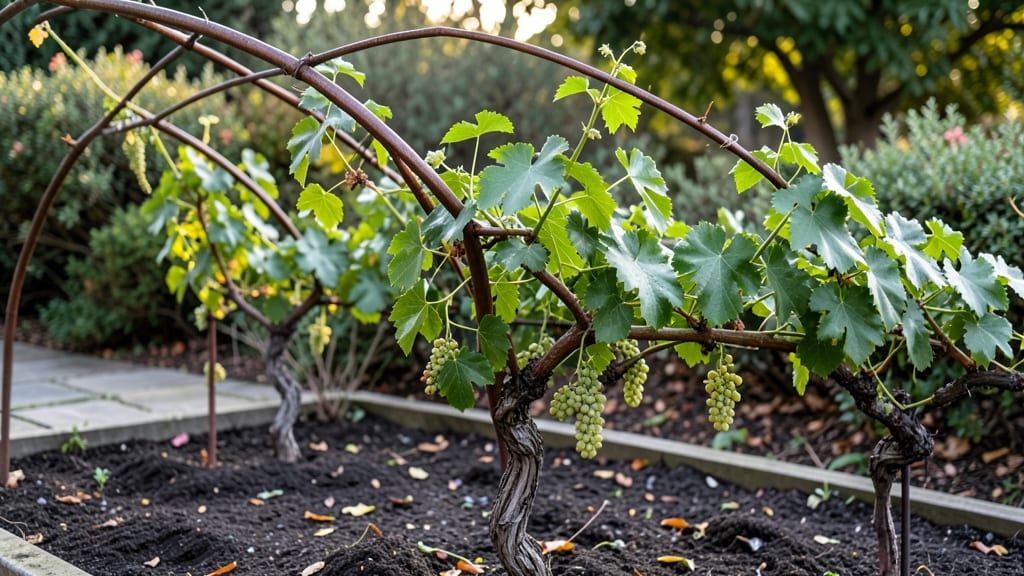
Grape trees look nothing like the sprawling vines you might picture—their lobed leaves and arching canes set them apart from anything else in your yard. 🌿 I’ll never forget the first time I spotted one in a neighbor’s garden: the deep green, five-pointed leaves looked almost like tiny maple trees, while the thick, gnarled canes curved dramatically toward the sky.
That’s when I realized grape trees aren’t just for vineyards—they’re striking landscape stars.
The real giveaway? Their distinctive palmate leaves—three to five pointed lobes radiating from a single stem, with jagged edges that catch the light. In spring, new shoots emerge bright red, while mature bark develops a rough, dark texture with deep furrows.
Even in winter, the curved canes remain visible, creating an artistic silhouette against bare branches. No other tree or vine combines this leaf shape with such bold structural lines.
By summer, you’ll spot clusters of tiny green berries forming at the leaf axils, eventually ripening into the grapes you know (or the wild, bird-friendly varieties if you’re not pruning for harvest).
The way they climb naturally makes them perfect for arbors, pergolas, or even as standalone focal points—imagine a single tree trained against a fence, its leaves filtering sunlight into dappled patterns. It’s the kind of plant that turns heads without trying.
Whether you’re designing a backyard retreat or just curious about that strange-looking tree in your neighborhood, grape trees bring year-round interest—spring’s fresh foliage, summer’s fruit, autumn’s golden hues, and winter’s skeletal elegance.
The key is spotting those lobes and canes early, before the vines take over the conversation. Ready to identify yours?
📚 In This Guide
- What you need
- Instructions
- Tips and common mistakes
- Wrapping up and next steps
What you need
- ● Garden gloves (1 pair) – Protect your hands while inspecting leaves and canes.
- ○ Hand lens or magnifying glass (optional but helpful) – For close-up views of leaf details.
- ● Camera or smartphone – Capture photos of leaves, canes, and bark for comparison.
- ● Field guidebook or plant ID app (e.g., iNaturalist, PictureThis) – Cross-reference your findings.
- ● Measuring tape or ruler – Check leaf size (typically 2–6 inches long for grapevines).
- ● Notebook & pen – Jot down observations like leaf shape, vein patterns, and cane curvature.
- ● Basic knowledge of leaf anatomy – Familiarize yourself with terms like lobed, serrated edges, and palmate veins.
- ● Access to a grapevine reference – Compare your findings to images of Vitis species (e.g., Vitis vinifera, Vitis labrusca).
- ● Time of year awareness – Grapevines look different in spring (new leaves) vs. fall (dormant canes).
- ● Safety first! – Avoid touching unknown plants if you suspect pests or thorns.
- ● Pruning shears – For safely collecting small cane samples (if permitted).
- ● Portable UV light – Some grapevine leaves fluoresce under UV, aiding ID.
- ● Local horticulturist contact – For expert verification in your region.
- ● Weather-resistant bag – Store leaf samples if you need to compare later.
How to identify grape trees by their unique features
Here's how to spot them in your yard or while foraging—no gardening experience needed.
🌿 Step 1: Examine the Leaves for Classic Lobes
Grape tree leaves are the easiest giveaway. Look for 5-7 rounded lobes that create a hand-like shape when fully grown. Each lobe has a slightly serrated edge and a pointed tip, almost like a miniature maple leaf but with smoother curves. Hold the leaf up to light—you'll see a palm-shaped vein pattern where the lobes meet the central stem.
Here's the thing—young leaves start out smooth and unfurled, so wait until they've matured a bit. The lobes become more pronounced as the leaf expands. If you see a leaf that looks like a five-fingered hand, that's your clue. Compare it to nearby trees: oak leaves are more jagged, while grape leaves are softer and more rounded.
🌱 Step 2: Check the Canes for Signature Curves
The woody stems (canes) of grape trees grow in distinctive arches and curves, often forming a U or V shape when mature. Young canes are smooth and greenish-brown, but older ones develop a rough, corky texture that's easy to feel. Run your fingers along the stem—if it feels ribbed and uneven, that's a grapevine.
Look for buds arranged in clusters along the canes. These buds are small, rounded, and often have a slightly fuzzy appearance. Unlike many fruit trees, grape canes don't grow straight up—they lean outward and curve, sometimes even trailing along the ground if unpruned. This growth habit helps them capture sunlight in dense forests or vineyards.
☀️ Step 3: Look for Clusters of Berries (If in Season)
When grapes are in fruit, the clusters are unmistakable. Look for loose, cylindrical bunches of small, round berries that hang downward. The berries start green, then turn purple, red, or black depending on the variety. Each grape is smooth and glossy when ripe, with a stem that attaches to the cluster at a slight angle.
Here's what to watch for: grape clusters are not tightly packed like some berries. They have space between each grape, and the stems are woody and thick. If you see a tree with these clusters, it's almost certainly a grapevine—even if the leaves aren't fully lobed yet. The berries are a dead giveaway in late summer and fall.
✂️ Step 4: Compare to Common Look-Alikes
Grape trees are often confused with wisteria, Virginia creeper, or even young oak trees. Virginia creeper has five leaflets (not lobes), while wisteria has long, dangling flower clusters and compound leaves. Press the leaf between your fingers—grape leaves are thicker and more leathery than many vines.
Real talk: the biggest mistake is assuming a tree is a grapevine just because it has clusters. Poison ivy can have grape-like leaves, but its leaves are shinier and have three points (remember: "leaves of three, let it be"). Grape leaves are always palmately lobed, never divided into separate leaflets. If you're unsure, snap off a small twig and look for those curved canes and fuzzy buds—that's your final clue.
Tips & tricks for identifying grape trees with confidence
These little details make all the difference when you're trying to spot grape trees in the wild.
The Leaf Light Test: Hold a grape leaf up to sunlight and look through it—the veins should form a perfect palm shape where the lobes meet the stem. This is your best clue when leaves aren't fully mature yet. I've seen people mistake young grape leaves for oak because they're not fully lobed, but the vein pattern gives it away every time.
Seasonal Clues: In late spring, look for new growth that's slightly fuzzy along the stems. This fuzzy texture disappears as the canes mature, but it's a great identifier for young grapevines. I always check for this when I'm foraging—it's like nature's little warning label that says "grapevine ahead!"
Berry Shape Matters: When you see grape clusters, focus on their shape—loose, cylindrical bunches with space between each grape. Tight clusters belong to different plants. I've seen people assume wild grapes were edible because they looked similar to store-bought grapes, but the loose arrangement is a dead giveaway for grapevines specifically.
Texture Check: Press a leaf between your fingers—grape leaves are noticeably thicker and leathery compared to other vines. This thickness helps them hold up to pests and harsh weather. I learned this the hard way after mistaking Virginia creeper for grapes; the texture difference is what saved me from making a dangerous mistake.
Pro Tips for What Do Grape Trees Look Like
- These little details make all the difference when you're trying to spot grape trees in the wild.
- The Leaf Light Test: Hold a grape leaf up to sunlight and look through it—the veins should form a perfect palm shape ...
- Seasonal Clues: In late spring, look for new growth that's slightly fuzzy along the stems. This fuzzy texture disappe...
Frequently asked questions
How can I tell if a vine is a grapevine and not just a random bush?
A grapevine’s lobed leaves (usually 3–7 pointed sections) and curved canes (thick, woody stems) are dead giveaways. Unlike ivy or wisteria, grapevines have hairy tendrils and grow in a sprawling, trellis-friendly pattern. Check for small green grapes in summer—even if they’re tart!
When is the best time to plant a grapevine for maximum growth?
Plant in early spring (after frost risk passes) or late fall (6–8 weeks before freezing temps). Young vines need time to establish roots before winter. Avoid summer planting—heat stress can stunt growth. Pro tip: Soak roots in water for 1–2 hours before planting to reduce transplant shock!
Can grapevines grow in containers, or do they need a big yard?
Yes! Dwarf or patio grape varieties (like ‘Thompson Seedless’ or ‘Concord’) thrive in 15–20 gallon containers with drainage holes. Use a well-draining potting mix and a trellis for support. Just know: container vines may produce smaller yields than in-ground plants. Rotate pots yearly to prevent root circling.
Why are my grapevine leaves yellowing or curling? Is it a disease or pests?
Yellowing leaves often signal nutrient deficiency (add compost or a balanced fertilizer) or overwatering (grapevines hate soggy roots). Curling could mean aphids, spider mites, or powdery mildew. Spray leaves with neem oil or insecticidal soap for pests. For mildew, improve airflow and apply baking soda spray (1 tsp baking soda + 1 quart water + a drop of soap).
How long does it take for a grapevine to produce fruit after planting?
Patience is key! Most grapevines take 2–3 years to bear fruit, though some vigorous varieties (like ‘Crimson Seedless’) may fruit in 1–2 years with ideal care. Prune aggressively in winter to encourage fruiting canes. Bonus: Young vines focus on growth first—don’t expect wine-quality grapes right away!
Do grapevines need full sun, or can they handle partial shade?
Grapevines love full sun (6–8+ hours daily) for sweet, flavorful grapes. Partial shade (e.g., morning sun + afternoon shade) can work in hot climates but may reduce yield and sugar content. If shading is unavoidable, choose shade-tolerant varieties like ‘Black Monukka’ and prune to improve airflow.
Wrapping up and next steps
Now that you’ve learned to spot a grape tree by its lobed leaves, curved canes, and distinctive growth habit, you’re well on your way to becoming a grape tree pro! 🌿 Whether you’re identifying one in your backyard or planning your own vineyard, recognizing these key features makes the process simple and rewarding.
Ready to take the next step? Visit a local nursery or botanical garden to compare real grape trees with your new knowledge—or start researching varieties that thrive in your climate. Happy tree-spotting! 🍇